Books that helped me form my ILEA objects and CRP #4
- adey1855
- Jan 1, 2023
- 5 min read

Updated: Jan 4, 2023
1. Nomadic Furniture – Hennessey and Papanek

This book was published in the 1970s and yes, it gave me a plethora of ideas related to the ILEA project. Printed in the classical "handwriting" typeface, I have seen many similar books from the same era; but this book manages to impart a sense of a lifestyle that, while fleeting, appears to be circling back into popular consciousness. The furniture in this book is designed to assist proper geometric alignment of the human form, to be stylish or at least to make an aesthetic statement, and to promote the life of one who is on the move, or at least someone who requires that their furniture be ready to pack up at a moment's notice. Some of the ideas are completely insane. The cardboard car seat in the section for children, for example, meets approximately 0% of modern safety requirements, and the "bubble lamp" made from "used Styrofoam cups" is the sort of thing that haunts my nightmares. But some of them are quite good - the boxes with lids that can be used as packing crates, and then re-assembled into a stylish ladder-style bookshelf. Most of the projects don't include specific instructions, tools, specifications, measurements, or anything else that would hinder the creator. They are ideas, not entirely hatched or ready to be executed, but I feel like they are a jumping off point for a better world.
2. Design is a state of mind – Martino Gamper

The book is based on selected works of renowned Designers which were thoughtfully curated by Martino Gamper and exhibited at Serpentine Gallery (2014). Through exhibition, the London based Italian designer pays homage to contemporary design highlighting objects that have made a significant impact on our lives and offer new perspectives on material culture. Somehow, I was able to co-relate with this book, maybe because of the kind of object that I had chosen from the ILEA collection. The book consists of a 22-page interview focusing on why he chose these particular objects and why it’s important to be remembered by many.
3. Olafur Eliasson – Reality Machines

Olafur Eliasson has gained an international following by making architecture disappear. Many of his best-known works have subsumed the fixed geometries of institutional buildings into more fluid and ephemeral environments in which the viewer’s perception of space is shaped less by the layout of walls and floors than by the manipulation of atmospheric conditions, such as temperature or light.
From my perspective, A common question that we face today looking at his variety of work – is whether art and architecture are racing each other for eye-popping entertainment value or the transgressive frisson between the two disciplines are still possible.
4. Why Materials Matter – Seetal Solanki

Great book! Talks about materials through the lens of projects that are immediately relevant as opposed to speculative.It’s a fascinating to look at how art, design, and forms can be made from recycling and resourcefulness. A responsible approach into making the world a more beautiful and sustainable place.
It explores, for example, how ancient practices such as dyeing fabric and making glue may hold the secret to renewable and earth-friendly consumer products, as well as how recycling plastics can tackle food waste, and how a type of light metal being developed may one day make air travel less fuel-reliant.
From my observation, it is very Eurocentric, with a few projects from the East. Surprising lack of projects from the Americas. Makes me wonder if they're not working on materials over there, or if the London-based author didn't look that far.
5. Radical Matter - Kate Franklin and Caroline Till

This book celebrates the designer and maker as an agent for radical change, disrupting the way we design, make and consume through material innovation.
What does it mean to live in a material world, and how do materials of the past and present hold the keys to our future? This book tackles these questions by focusing on various issues that human beings face and by discussing potential materials-related solutions. Rejecting old assumptions and revitalizing the principles of sustainable production, Radical Matter reimagines material and process to provide the manifesto for a revolution in material innovation.
It’s a vital resource for those looking to understand how to connect materials with manufacturing and the means of distribution and consumption.
6. How to do your Case Study – Gary Thomas

This book introduces students and researchers to the basics of case study research. Being insightful and vibrant, it grounds its advice in concrete experience and real-world cases. Using examples from across the social sciences, this book provides practical guidance on how best to read, design and carry out case study research with a focus on how to manage and analyse data.
It also addresses crucial issues around ethics and has improved coverage of key themes such as rigor, validity, generalization and the analysis of case studies. It demystifies case study research and answers important questions such as:
What is a case study?
When and why should case study methods be used?
How are case studies designed?
What methods can be used?
How do we analyse and make sense of our data?
How do we write up and write about our case?
I would personally recommend all the students to read this book as it is going to play a major role in the synthesis of CRP.
7. Thinking Through Craft – Glenn Adamson

A very compelling academic investigation on how to theorize craft in relation to art. Adamson engages this binary through complicating it at every turn, and provides various lenses through which he explores this key concept that while craft is not modern art, craft is used and set apart from modern art in ways that reveal how we think about topics such as skill, functionality, and success of trying to reclaim, reject, or embed craft and how the art world understands modern and/or contemporary art. As a student of design, I am eager to continue digging into Adamson's other books such as Fewer, Better Things and The Invention of Craft; although I haven’t completed this book. Ultimately the book's success is in the ways Adamson argues craft should be used to raise more questions in art, which is what he does with each of the examples of artists and movements he provides throughout the text. This leaves the reader then wondering, ok, so what do we do with this?
It's going to take a while to get through this one. There's a lot of interesting information, but at times the writing was too academic for my taste - which caused my mind to wander – what if I couldn't retain anything and would have to re-read entire sections.
8. Ceramic Form - Peter Lane & Postmodern Ceramics - Mark Del Vecchio
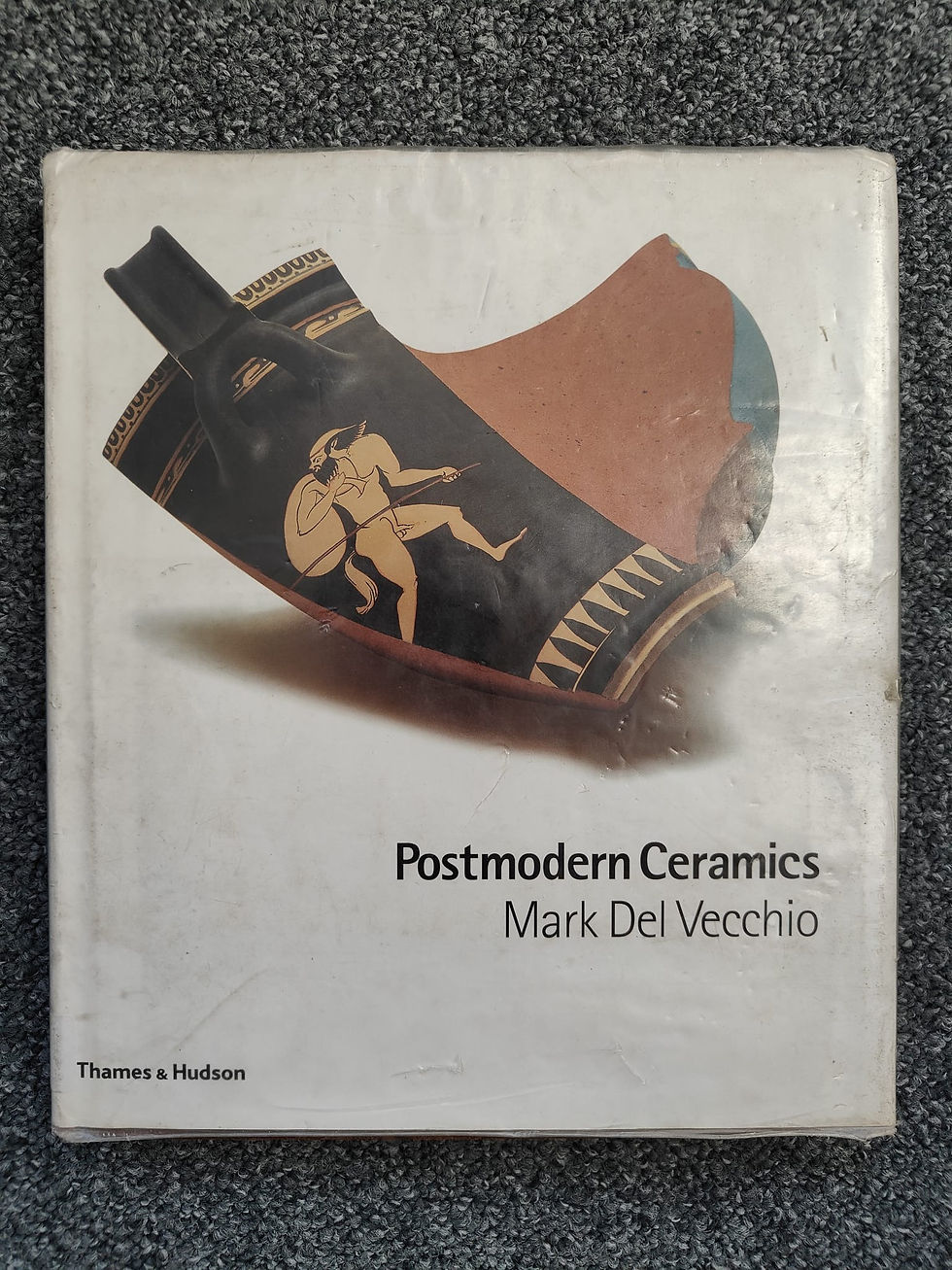
In Postmodern Ceramics, Mark Del Vecchio surveys the achievement of over 130 masters of contemporary ceramics from more than 25 countries, analyzing their various approaches by presenting their work in twelve themes: the postmodern look; post-minimalism; pattern and decoration; the multiple vessel; organic abstraction; the real/super-real; history, culture and time; the image and the vessel; the vessel as image; figural sculpture; abstract sculpture; and post-industrialism. It goes deep into the roots of postmodern ceramics, understanding the deeper meaning and memory behind it.

Ceramic Forms- Form has always been one of the most important aspects of ceramics and one that continues to challenge and stimulate potters throughout the world. Peter Lane puts forward the various elements involved in the design and making of ceramics by concentrating on the fundamental pottery vessels- basically tableware- which provide the basis for almost all others. This book provides excellent examples of how forms can be manipulated using a memory material(clay) and the studio techniques to get the results achieved.
9. Do it Yourself -Thomas Barnthaler

The book is based on 50 of the world’s most exciting designers who have devised simple objects that anyone can make at home. Affordable, accessible and inspirational, this book redefines DIY for the IKEA generation. Each easy-to-make project can be made with basic tools and everyday items.
Every project includes hand-drawn step-by-step illustrations and colour photographs to ensure success. Although this book isn’t really for the common man; the book helps the upcoming designers to kickstart a project. It acted as a manual for my ’10 days 10 objects’ assignment.


Comments